What it is
Every professional role has a displacement profile — a combination of tasks within it that are more or less vulnerable to automation, commoditization, or structural market change. Understanding your displacement profile in advance is not pessimism — it is the professional equivalent of knowing your health risks before they become symptoms. It allows you to act while the options are still open.
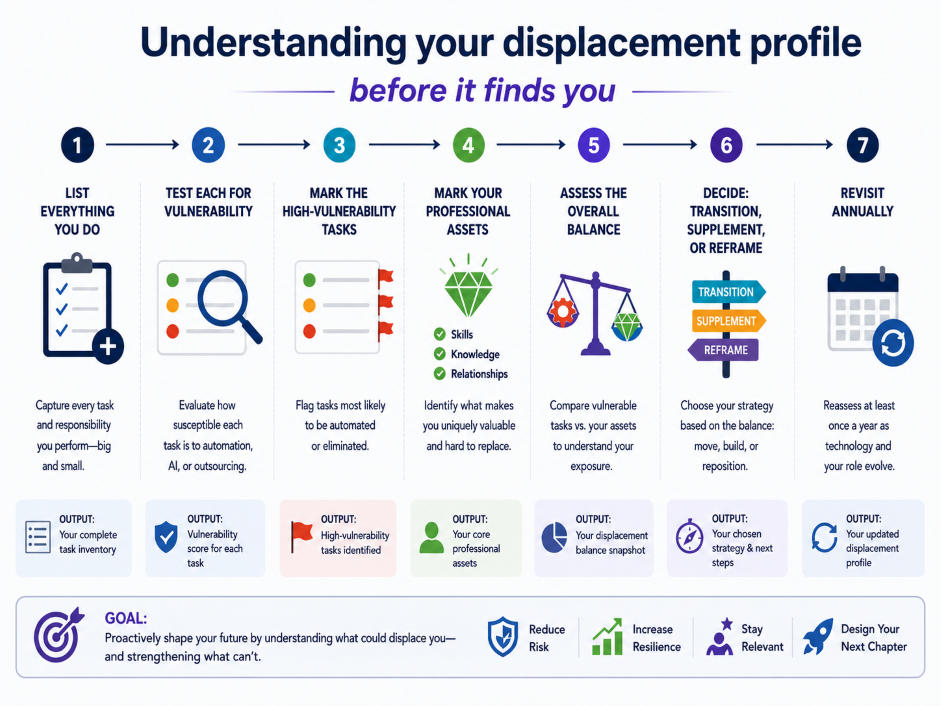
How to map yours
- List every significant thing you do professionally — tasks, outputs, decisions, relationships. Be specific and comprehensive.
- For each item, ask two questions: Could this be done by a well-designed AI tool today or in the near future? Could this be done by a lower-cost professional in the same market?
- Mark high vulnerability items — those where the answer to either question is 'yes, already, or very soon.' These are not necessarily things to abandon, but they are things to not be solely dependent on.
- Mark low vulnerability items — those that require judgment, trust, context, or original thought. These are your professional assets in a disrupted market.
- Assess the balance. If most of your current value comes from high-vulnerability tasks, you have a window — not a crisis. Act in the window.
- For each high-vulnerability item, determine whether to transition, supplement, or reframe it. Some will become less central to your offering. Others can be wrapped in higher-value judgment to remain relevant.
- Revisit the assessment annually. Displacement profiles shift. What was low-vulnerability two years ago may be different today.
In practice
A financial analyst maps their work across five categories. Three — data gathering, formatting, and initial draft commentary — are already partially automated in their organization. Two — client communication and interpretive judgment on complex cases — are not. Rather than treating this as alarming, the analyst shifts how they present their work: less time on data presentation, more on interpretive narrative and client implication. Over two years, their rate increases rather than compresses. The colleagues who did not shift see their contracts become competitive tenders on price.
Displacement finds those who did not look for it. Find your profile now, while you can choose your response.